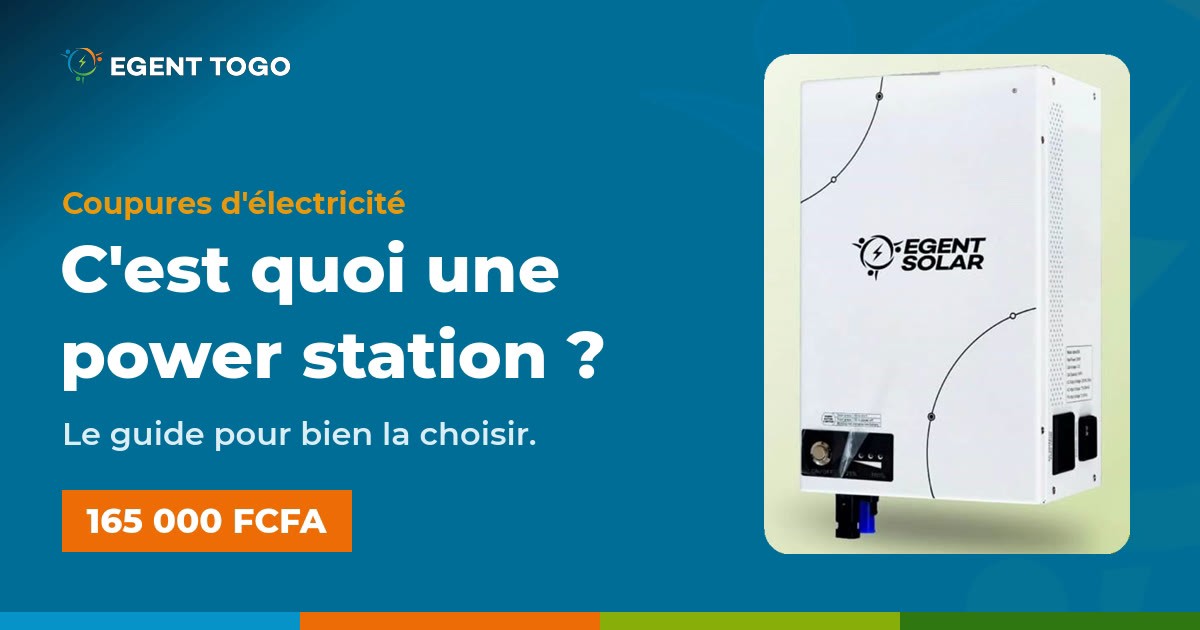
Power cuts: what is a power station and how do you choose the right one?
What is a power station? How do you choose the right power and battery capacity to get through power cuts? The simple guide from EGENT TOGO.
The power goes out. The TV switches off, the fan stops, the freezer starts to thaw and work grinds to a halt. Many Togolese then think of a generator. But there is a simpler, quieter and cleaner solution: the power station. Here is how it works and how to choose the right one.
What is a power station?
A power station is a big rechargeable battery with sockets. You plug it into the mains when there is power, it stores the energy, and when CEET cuts the power, it takes over. You plug your appliances into it and they keep running.
It combines three things in a single unit:
a battery, which keeps energy in reserve;
an inverter, which converts this energy so your appliances can use it;
sockets, to plug in lamps, phones, a TV or a computer.
At EGENT TOGO, this solution recharges from the grid whenever power is available. Later on, you can add solar panels to recharge it with the sun and become more independent.
How does it compare with a generator?
Noise: loud for a generator, silent for a power station.
Smoke and smell: yes for a generator, none for a power station.
Fuel to buy: yes for a generator, none for a power station.
Starting: manual for a generator, manual or automatic for a power station.
Indoor use: not recommended for a generator, safe for a power station.
The two numbers to look at
When you look at a power station, you mainly see two numbers. They do not mean the same thing, and mixing them up causes many mistakes.
Picture a water tank with a tap:
The tap is the power (in watts, W). It tells you how many appliances you can plug in at the same time.
The tank is the capacity (in watt-hours, Wh). It tells you how long you will last.
You can have a big tap with a small tank: everything works, but it empties quickly. Or the other way round. So you need to look at both.
1. Power: how many appliances at once?
If you plug in more than the power station can deliver, it goes into safety mode and shuts down.
How to work it out in three steps:
List the appliances you want to use during the outage.
Find the power of each one, written on the appliance label. If the label only gives volts (V) and amps (A), multiply them. For example, 220 V × 0.5 A = 110 W.
Add them up, then add about a quarter more (25%) to be on the safe side.
Average power of common appliances:
LED bulb: 5 to 10 W
Phone charger: 10 to 20 W
Internet box: 10 to 20 W
Fan: 40 to 80 W
Television: 50 to 100 W
Laptop: 50 to 100 W
Refrigerator: 100 to 200 W
Kettle, iron, hotplate, air conditioner: 1,000 W and more
Watch out for appliances that heat. A kettle, an iron or a hotplate use a huge amount of energy. It is better not to plug them into a power station. For an air conditioner or the whole house, you need a bigger solar kit, such as our Zoklin Kits.
2. Capacity: how long will I last?
Capacity is measured in watt-hours (Wh). When you see kWh, it is the same thing on a bigger scale: 1 kWh = 1,000 Wh.
To estimate how long it lasts, use this formula:
Duration in hours = capacity (Wh) × 0.85 ÷ power of your appliances (W)
We multiply by 0.85 because a small part of the energy is lost along the way: you only get back 85% of what is stored.
A real example: you have a 250 W, 1,000 Wh power station. You plug in the internet box (15 W), a computer (60 W) and two bulbs (10 W each). Total: 95 W, well below 250 W. Calculation: 1,000 × 0.85 ÷ 95 = about 9 hours of backup.
EGENT TOGO offers this model for 165,000 FCFA at its showroom in Totsi.
Which size should you choose? Three situations
1. Basic needs: lights, phones, internet
Plan for: 300 to 600 W of power, 300 to 500 Wh of capacity.
Example: 2 bulbs (20 W), 2 phones (20 W), the internet box (15 W), i.e. 55 W.
With 300 Wh: about 4 h 40. With 500 Wh: about 7 h 45.
2. Remote work and comfort: computer, TV, fan
Plan for: 800 to 1,200 W of power, 500 to 1,000 Wh of capacity.
Example: computer (60 W), TV (80 W), fan (60 W), internet box (15 W), 2 bulbs (20 W), i.e. 235 W.
With 500 Wh: about 1 h 50. With 1,000 Wh: about 3 h 35.
3. Well-equipped home, with a refrigerator
Plan for: 1,500 W of power or more, 1,500 Wh of capacity or more.
Example: refrigerator (150 W), TV (80 W), fan (60 W), internet box (15 W), 3 bulbs (30 W), i.e. 335 W.
With 1,500 Wh: about 3 h 50. With 3,000 Wh: about 7 h 35.
Good to know: a refrigerator does not run continuously; it stops and restarts. In practice, you will therefore last a little longer than the calculation.
If your outages last a long time, or if you want to power more appliances, take a look at our Zoklin Kits: they produce their own energy with solar panels and no longer depend on the grid.
The battery: why LiFePO4 is a good choice
Not all batteries are equal. LiFePO4 (lithium iron phosphate) batteries are known to be robust, safe and long-lasting.
They generally handle 2,000 to more than 5,000 full charge and discharge cycles before losing 20% of their original capacity. In daily use, that means 10 to 15 years of service.
In short
List your appliances and add up their power: that is the power (W) you need.
Think about how long your outages last: that is the capacity (Wh) you need.
Keep some margin, and choose a durable LiFePO4 battery.
Don't look for the biggest power station. Choose the one that matches what you actually use. It is the best choice for your comfort and your budget.
Not sure what you need? Visit the EGENT TOGO showroom or call us. We will work it out with you, free of charge.
📞 +228 92 53 14 55 / 91 20 43 73
🌐 www.egenttogo.com
📍 Lomé, Totsi district, showroom open
EGENT TOGO · Renewable Energy Ambassador · Energy Awards 2026
Related articles
Free Water: Cultivate Year-Round Without Electricity Bills
30 Sept 2026
Electricity Outages: What If You Produced Your Own Electricity with the Zoklin BB Kit?
21 Sept 2026
5 conseils pour entretenir vos panneaux solaires
25 Jun 2026
Florida: Babcock Ranch, the 100% solar-powered town since 2017
25 Aug 2026